Kia Sportage: Valve Body
Description and Operation
Description
The valve body is essential to automatic transaxle control and consists of various valves used to control the oil feed from the oil pump. Specifically, these valves consist of pressure regulator valves, oil redirection valves, shift valves, and manual valves. The body also features electronic solenoid valves that ensure smooth gear changes.
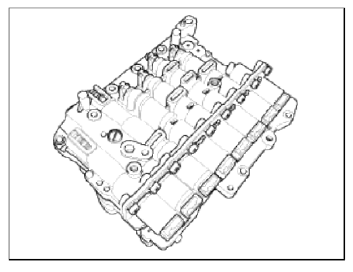
Components and Components Location
Components Location
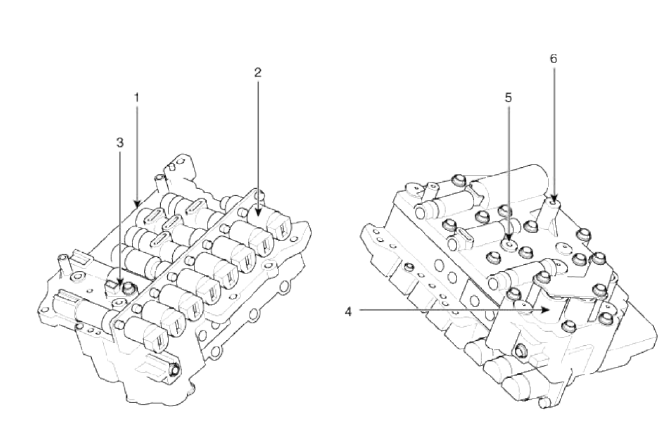
- PCV adjust screw
- Solenoid valve
- Oil temperature sensor
- Accumulator
- Low & reverse brake (LR/B) pressure flow hole
- Under drive brake (UD/B) pressure flow hole
Valve Body Flow
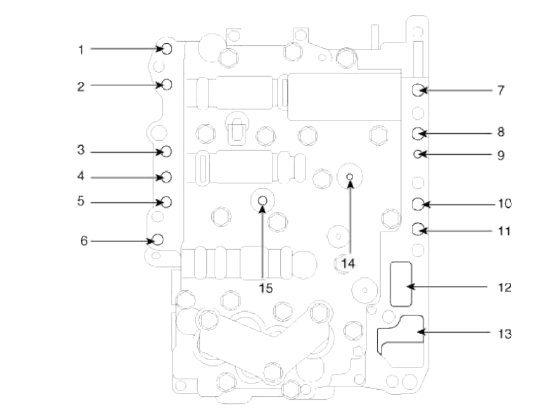
- To cooler
- From cooler
- Lubrication (rear)
- Overdrive pressure
- Reducing pressure (red2)
- Reducing pressure (red1)
- From damper pressure
- To damper pressure
- Lubrication (front)
- 35R clutch pressure
- 26 brake pressure
- From oil pump
- To oil pump
- Underdrive pressure
- Low & reverse pressure
Repair procedures
Removal
1. Remove the battery and the battery trау. (Refer to "Charging system" in EE group.)
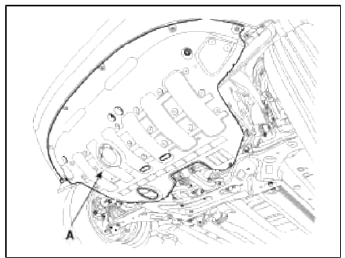
2. Remove the under cover (A).
Tightening torque: 19.6 ~ 24.5 N.m (2.0 ~ 2.5 kgf.m, 14.5 ~ 18.1 lb-ft)
3. Replace new gasket and the plug after draining the automatic transaxle fluid by removing the drain plug. (Refer to "Hydraulic system (Fluid)" in this group)
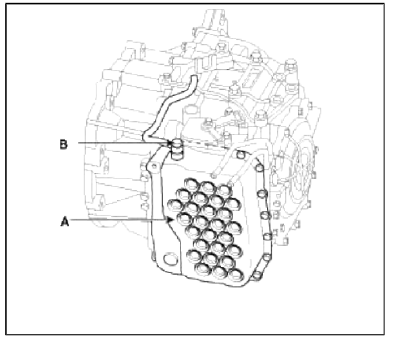
4. Remove the valve body cover (A) and eyebolt (B).
Tightening torque:
(A) 13.8 ~ 14.7 N.m (1.3 ~ 1.5 kgf.m, 9.4 ~ 10.8 lb-ft)
(B) 34.3 ~ 44.1 N.m (3.5 ~ 4.5 kgf.m, 25.3 ~ 32.6 lb-ft)
CAUTION
Always replace the gasket of the eyebolt use new one whenever loosening eyebolt.
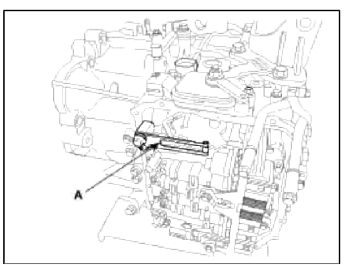
5. Remove the plate and the detent spring (A) after removing the bolt.
Tightening torque: 24.5 ~ 35.3 N.m (2.5 ~ 3.6 kgf.m, 18.1 ~ 26.0 lb-ft)
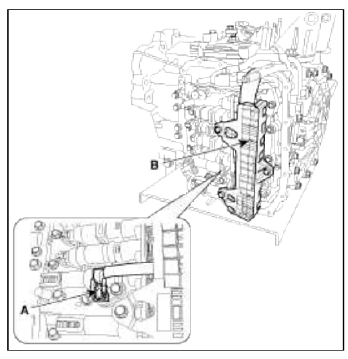
6. Remove the bolt (3ea) after disconnecting the solenoid valve (B) connector and the oil temperature sensor connector (A).
Tightening torque: 9.8 ~ 11.8 N.m (1.0 ~ 1.2 kgf.m, 7.2 ~ 8.7 lb-ft)
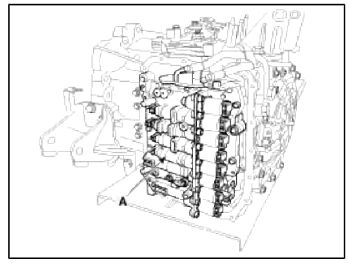
7. Remove the valve body assembly (A).
Tightening torque: 9.8 ~ 11.8 N.m (1.0 ~ 1.2 kgf.m, 7.2 ~ 8.7 lb-ft)
Installation
1. Installation is the reverse of removal.
CAUTION
After replacement or reinstallation procedure of the valve body assembly, must perform procedures below.
NOTE
- Continue to apply liquid gasket at application points at the valve body cover with Ø2.5mm (0.0984in.) thickness.
Liquid gasket Part name : Threebond 1281B or LOCTITE FMD-546
- Adding automatic transaxle fluid. (Refer to "Hydraulic system (Fluid)" in this group)
- Perform TCM learning after replacing the valve body to prevent slow transaxle response, jerky acceleration and jerky startup. (Refer to "Automatic transaxle control system (Repair procedures)" in this group)
READ NEXT:
 Description and Operation, Components and Components Location | Flow Diagram
Description and Operation
Description
The 6-spd automatic transaxle consists of an overdrive clutch (OD/C), a one-way clutch (OWC), a lower and reverse brake (LR/B), an underdrive brake (UD/B
SEE MORE:
Seat belt precautions
Take the following precautions when
using seat belts.
Infant or small child
All 50 states have child restraint laws.
You should be aware of the specific
requirements in your state. Child and/or
infant seats must be properly placed
and installed in the rear seat. For more
information about
Tire chains
Wire-type
Fabric-type
Since the sidewalls of radial tires are
thinner, they can be damaged by
mounting some types of snow chains on
them. Therefore, the use of snow tires is
recommended instead of snow chains.
Do not mount tire chains on vehicles
equipped with aluminum wheels; snow c
Content
- Home
- Kia Sportage - Fifth generation (NQ5) - (2022-2026) - Owner's Manual
- Kia Sportage - Second generation (JEKM) (2005-2015) - Body Workshop Manual
- Kia Sportage Third generation (SL) - (2011-2016) - Service and Repair Manual
- Sitemap
- Top articles
